Eli Lilly (LLY) Stock Surges on Blockbuster Q1 2026 Earnings: GLP-1 Drug Boom Drives Record Revenue, Profit Growth, and Raised Full-Year Outlook
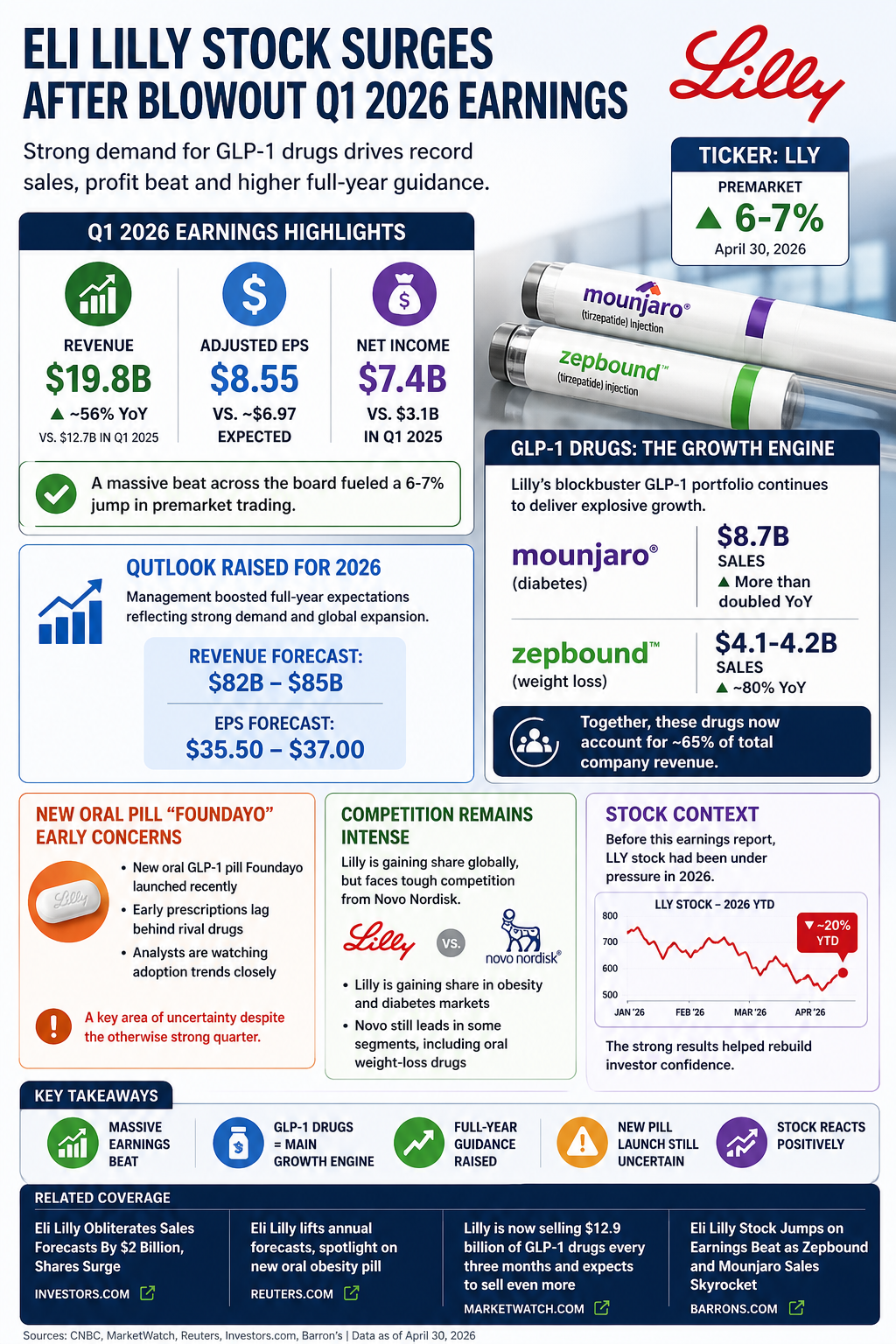
The stock performance of LLY has become one of the most closely watched stories in the global pharmaceutical and equity markets in 2026. Following the company’s first-quarter earnings release, investors witnessed a powerful combination of explosive revenue growth, strong profitability, and renewed confidence in long-term guidance. These results not only exceeded Wall Street expectations but also reinforced Eli Lilly’s dominant position in the rapidly expanding obesity and diabetes treatment market—particularly through its GLP-1 drug portfolio.
To better understand recent price movement and investor sentiment, here is a live market chart:
At the core of Eli Lilly’s strong performance lies its blockbuster GLP-1 drugs, especially Mounjaro and Zepbound. In Q1 2026, the company reported total revenue of approximately $19.8 billion, representing an impressive 56% year-over-year increase. This growth was largely driven by unprecedented demand for weight-loss and diabetes treatments, a segment that has transformed the pharmaceutical industry into one of the fastest-growing sectors globally.
Profitability followed the same upward trajectory. Eli Lilly posted adjusted earnings per share (EPS) of $8.55, significantly beating analyst expectations, which were below $7 per share. Net income reached roughly $7.4 billion, more than doubling compared to the same quarter last year. This sharp rise in earnings demonstrates the company’s ability not only to generate revenue but also to convert it efficiently into profits—a key metric for institutional investors.
One of the most critical drivers behind this performance is the company’s GLP-1 drug segment. Mounjaro alone generated approximately $8.7 billion in sales during the quarter, more than doubling year-over-year. Meanwhile, Zepbound contributed over $4 billion, reflecting strong demand in the obesity treatment market. Together, these drugs now account for a substantial portion of Eli Lilly’s total revenue, underscoring the company’s strategic focus on metabolic diseases.
The broader significance of this growth lies in the global obesity drug market, which is projected to reach hundreds of billions of dollars in the coming years. Eli Lilly is currently competing head-to-head with Novo Nordisk, particularly in the GLP-1 segment. While both companies are experiencing strong demand, Eli Lilly’s injectable treatments have shown remarkable momentum, helping it gain market share internationally.
However, not all developments were uniformly positive. The company recently introduced an oral GLP-1 drug, Foundayo, which is designed to compete with pill-based alternatives from competitors. Early adoption of this product has been slower than expected, raising concerns among analysts about Eli Lilly’s ability to dominate the oral segment. Initial prescription data showed that uptake lagged behind rival offerings, highlighting the challenges of entering a competitive and rapidly evolving space.
Despite these concerns, investor sentiment remains largely optimistic. Following the earnings announcement, Eli Lilly’s stock surged by around 6% in premarket trading, reflecting strong confidence in the company’s growth trajectory. Analysts have pointed to the company’s ability to consistently outperform expectations as a key reason for bullish outlooks.
Another major highlight from the earnings report was the company’s decision to raise its full-year guidance. Eli Lilly now expects total revenue for 2026 to fall between $82 billion and $85 billion, up from previous estimates. Additionally, projected EPS has been increased to a range of $35.50 to $37.00. This upward revision signals management’s confidence in sustained demand for its products and continued expansion in global markets.
From a strategic perspective, Eli Lilly is also investing heavily in future growth through acquisitions and research. The company has recently engaged in multi-billion-dollar deals to expand its pipeline and strengthen its position in biotechnology innovation. These moves indicate a long-term strategy focused not only on current blockbuster drugs but also on developing the next generation of therapies.
Despite the strong quarterly performance, it is important to note that Eli Lilly’s stock had experienced volatility earlier in the year. Prior to the earnings release, shares were down more than 20% year-to-date, largely due to concerns about competition, pricing pressures, and regulatory scrutiny in the pharmaceutical sector. However, the latest results appear to have reversed some of this negative sentiment, reinforcing the stock’s long-term growth narrative.
For investors, the key takeaway is that Eli Lilly is currently operating at the intersection of two powerful trends: rising global demand for obesity treatments and rapid innovation in pharmaceutical technology. The company’s ability to scale production, maintain pricing power, and expand internationally will be critical factors in determining its future stock performance.
In conclusion, Eli Lilly’s Q1 2026 earnings report represents a pivotal moment for both the company and its stock. With record-breaking revenue, strong earnings growth, and upgraded guidance, the company has reaffirmed its leadership in the healthcare sector. While challenges remain—particularly in the oral GLP-1 market—the overall outlook for LLY remains highly positive. For long-term investors, Eli Lilly continues to be a compelling growth story driven by innovation, market demand, and strategic execution.